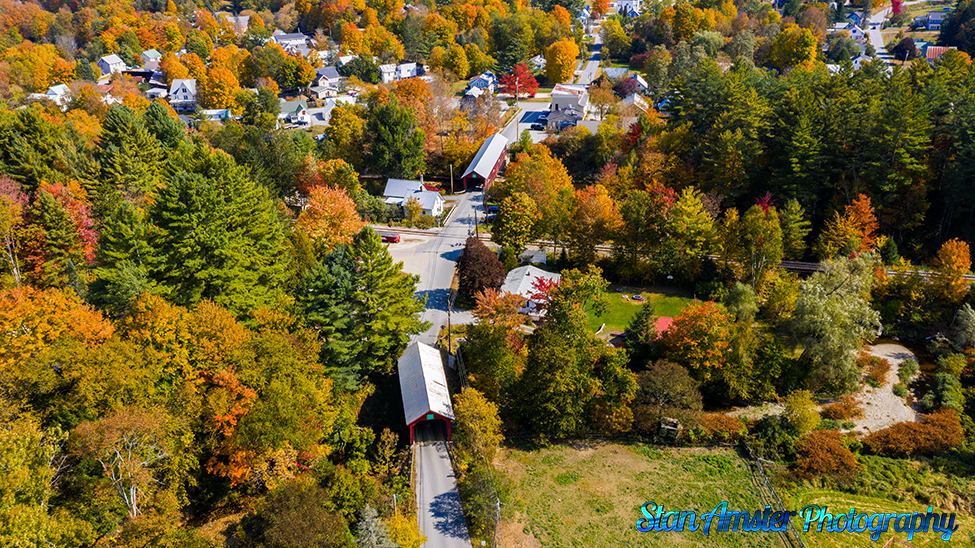
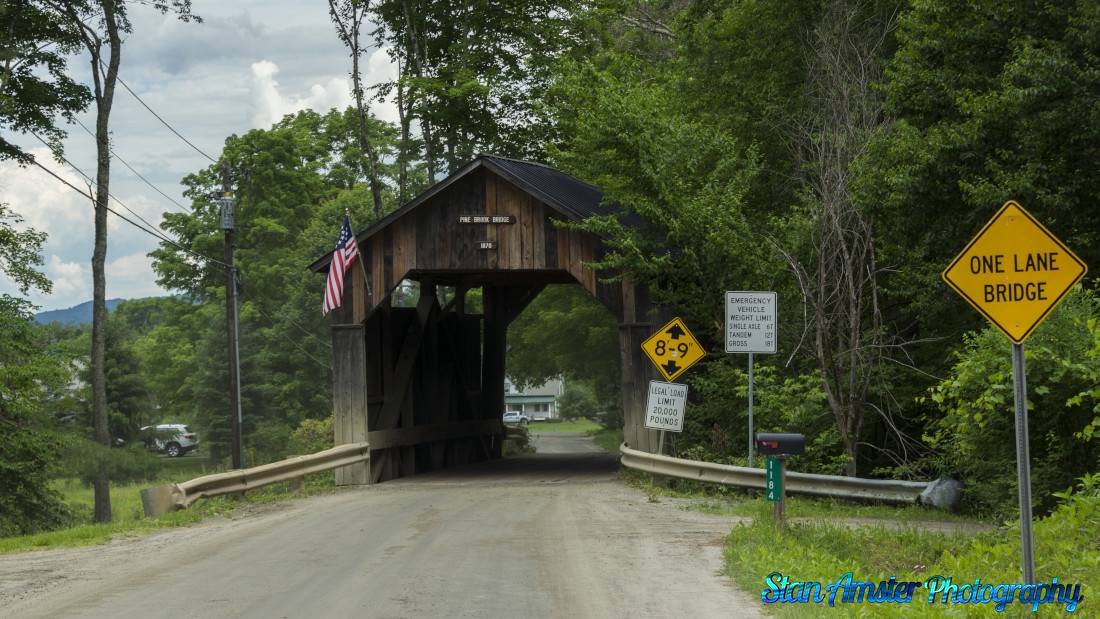
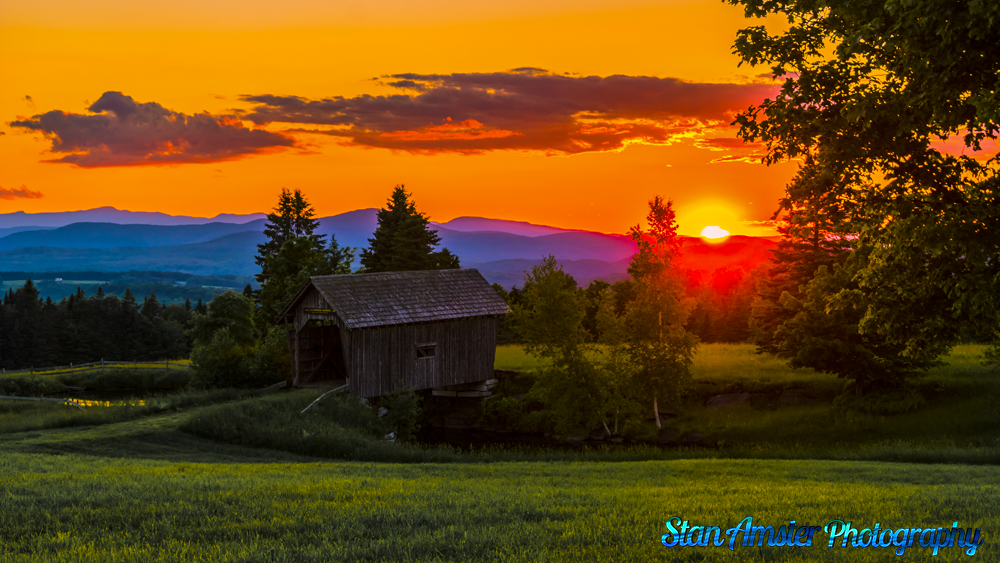
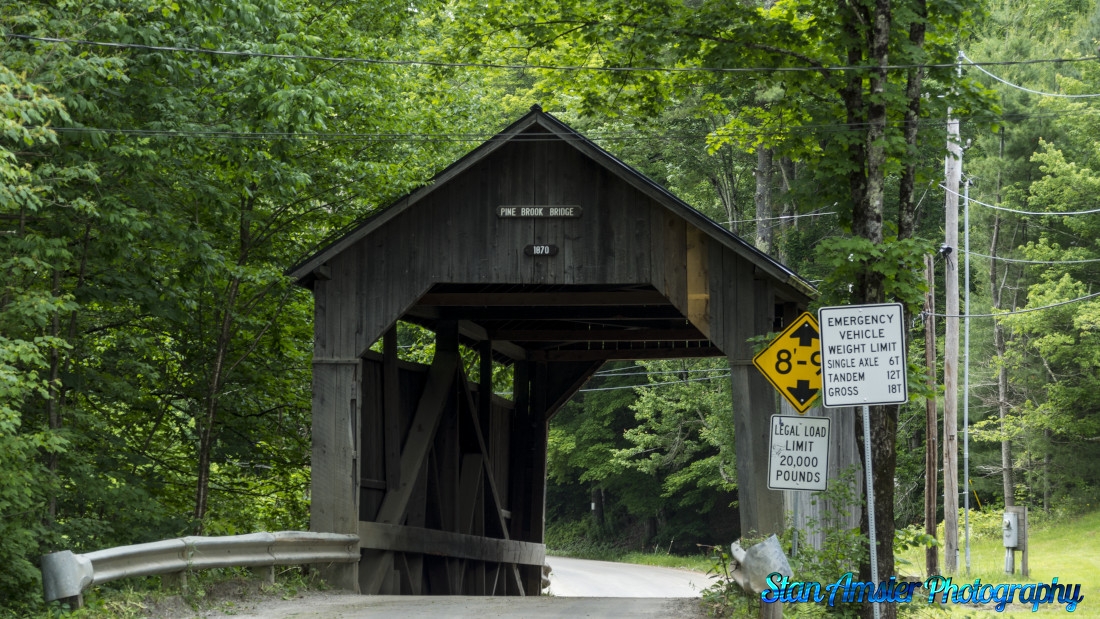
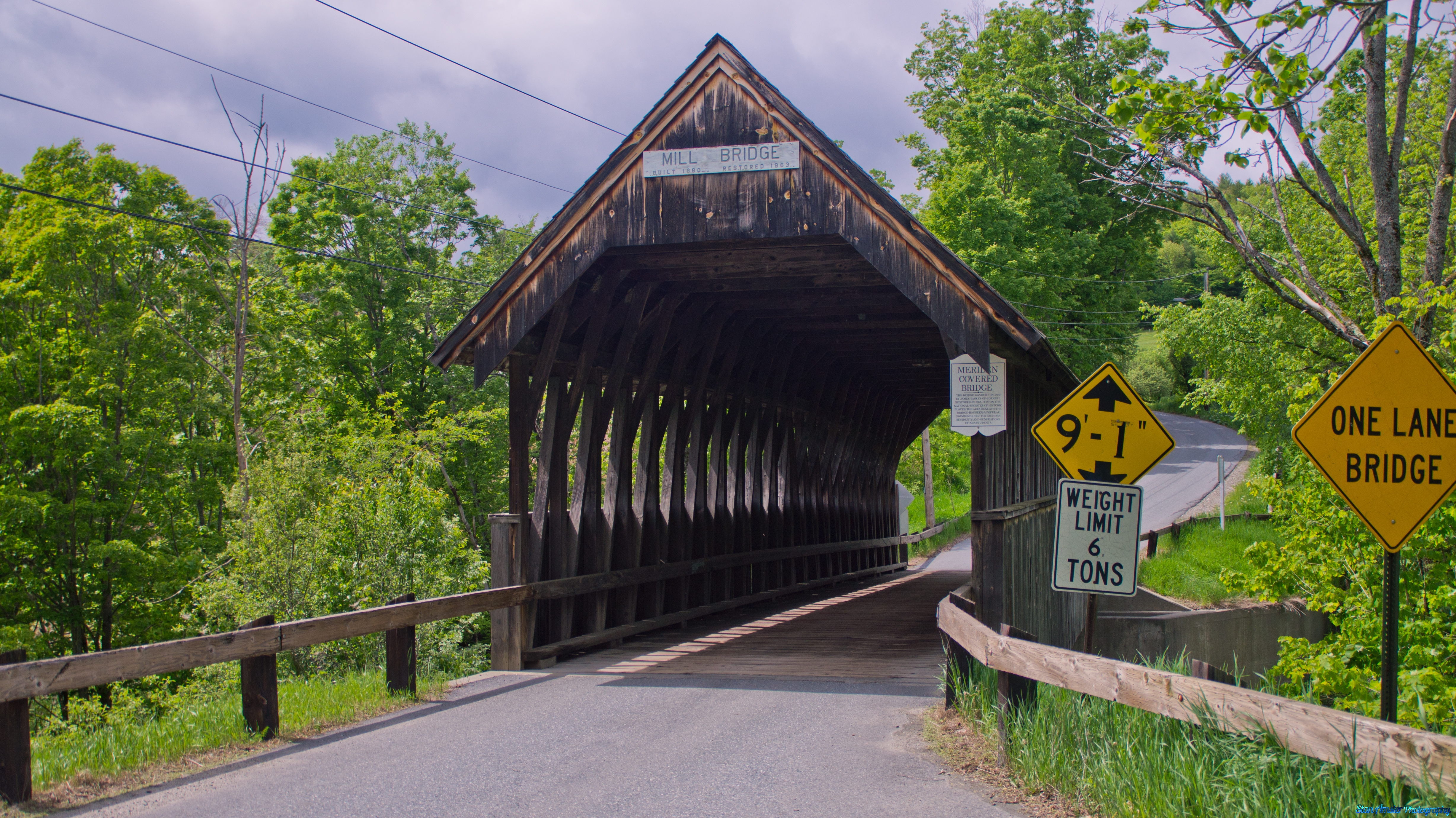
Another view of the Lower Cox and Station Covered Bridges in Northfield Vermont
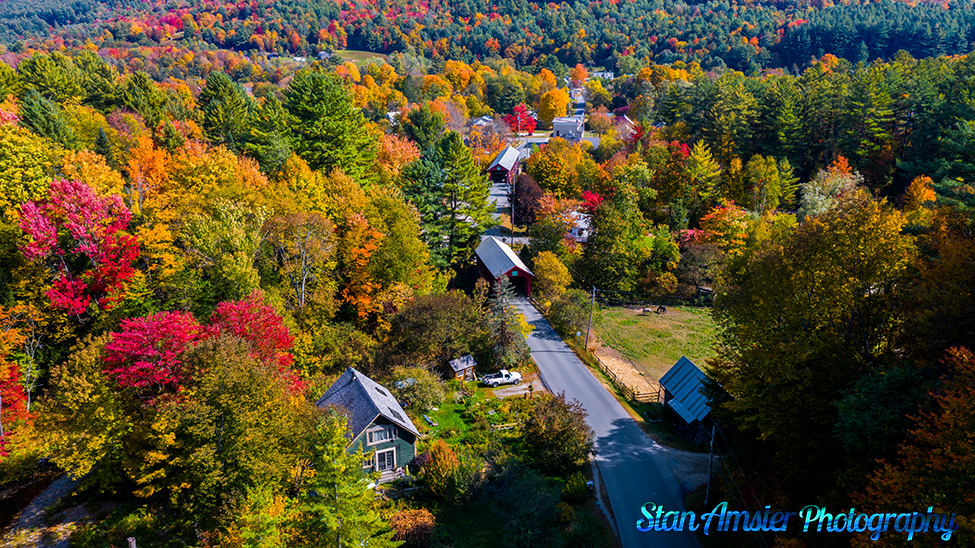
Another view of the Lower Cox and Station Covered Bridges in Northfield Vermont Read More »
Stan Amster Photography – New England Landscape & Commercial Photographer

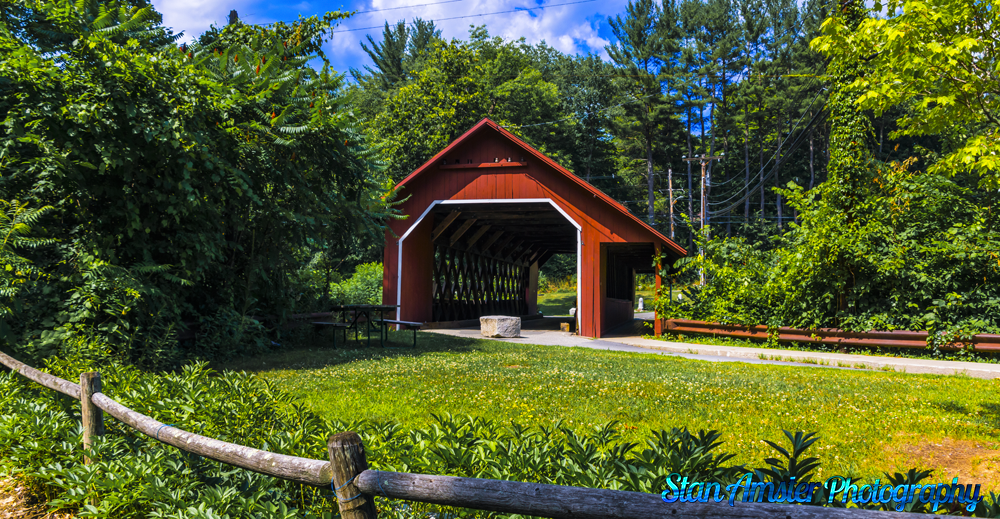
The Creamery Covered Bridge is a historic covered bridge in West Brattleboro, Vermont. Now closed to traffic, the Town lattice truss bridge formerly carried Guilford Road across Whetstone Brook, just south of Vermont Route 9. Built in 1879, it is Brattleboro’s last surviving 19th-century covered bridge.
The Creamery Covered Bridge is about 1.5 miles (2.4 km) west of downtown Brattleboro, just south of Vermont Route 9 and west (upstream) of the current alignment of Guilford Road, which it previously carried. The bridge is 80 feet (24 m) long and 19 feet (5.8 m) wide, and rests on stone abutments, one of which has been faced in concrete. The roadway is 15 feet (4.6 m) wide, and an attached sidewalk on the downstream side is 5.5 feet (1.7 m) wide. The bridge is topped by a roof that is slate over the roadway and metal over the sidewalk. The bridge trusses, built to the patented design of Ithiel Town, are protected by vertical board siding that rises about half their height, with a similar wall outside the sidewalk. Guy wires attached to the upstream side provide additional lateral support.
The bridge was built in 1879 out of spruce lumber, and the sidewalk was added about 1920. It is the last of what were once a large number of covered bridges in Brattleboro, and is the only covered bridge visible from Route 9 anywhere along its length, making it a significant tourist attraction. The bridge was closed to traffic in 2010.
Creamery Covered Bridge in West Brattleboro Vermont Read More »
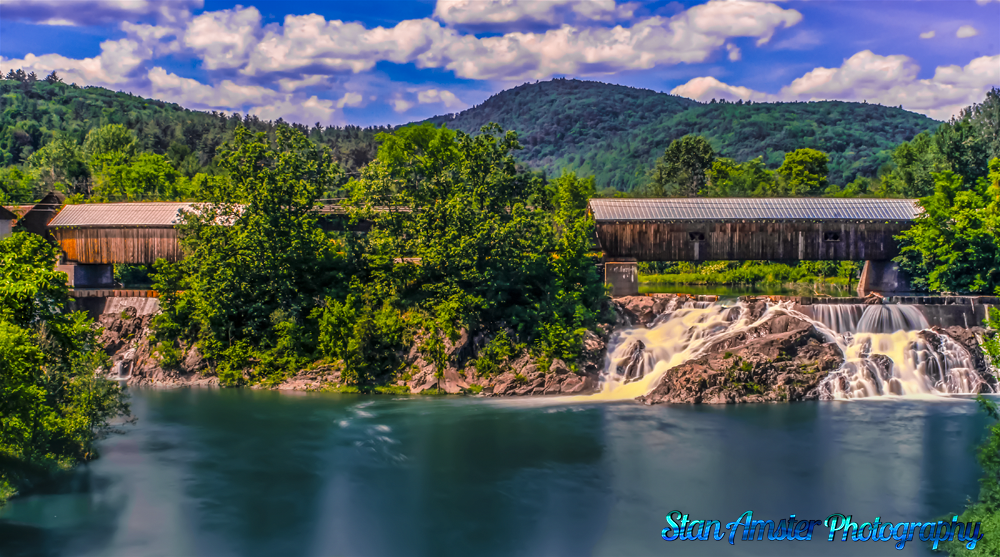
I will NEVER attempt to take this picture again. Scared was an understatement.
Willard “Old Bridge”
Originally built in 1870, the “Old Bridge” in the background was later renovated in 1953 and repaired in 1979. The bridge spans 128 feet and is sometimes referred to as the North Hartland East Covered Bridge. It was listed on the National Register of Historic Places in August, 1973.
Willard “New Bridge”
There were always two covered bridges at this location. The original second bridge (in the foreground) was built circa 1872, but was replaced in 1938 when the original was lost in the September hurricane of that same year. Many years later in 2001, when it began to deteriorate, the “New Bridge” was constructed and stands there still today. This bridge is also known as the North Hartland West Twin Covered Bridge.
Willard Twin Covered Bridges in Hartland Vermont Read More »
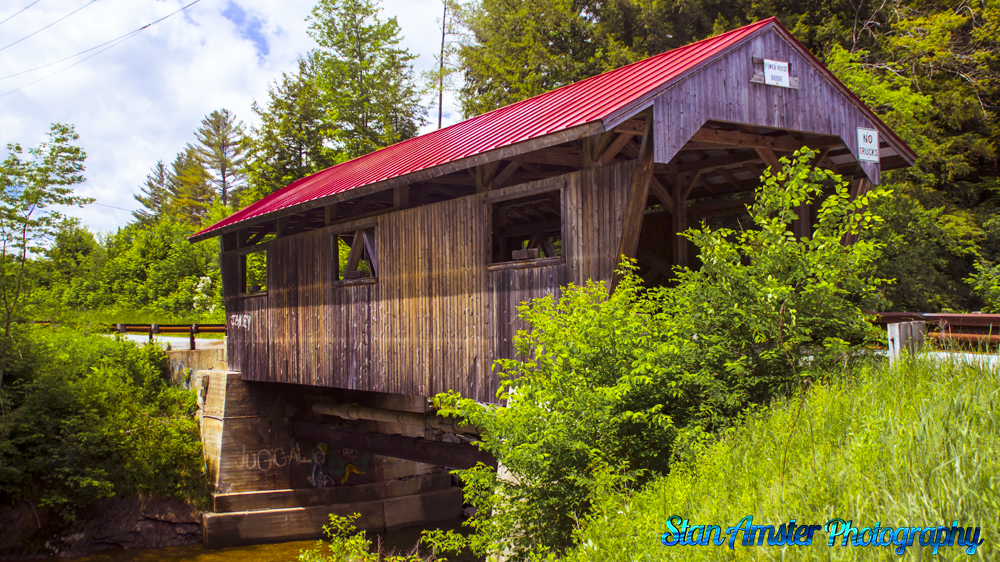
The Power House Covered Bridge, also known as the School Street Covered Bridge, is a covered bridge from 1872 that crosses the Gihon River off State Route 100C in Johnson, Vermont, US. It was listed on the National Register of Historic Places in 1974. The bridge’s name is from a now obsolete hydroelectric generating station just upstream from it. The bridge is of Queen post truss design by an unknown builder.
The Power House Covered Bridge is located east of the village of Johnson, on School Street just west of Vermont Route 100C. It cross the Gihon River, a tributary of the Lamoille River in a roughly east–west orientation. It is a single-span Queen post truss structure, 63.5 feet (19.4 m) long and 19 feet (5.8 m), with a roadway width of 16 feet (4.9 m) (one lane). The bridge rests on stone abutments faced in concrete, and is covered by a gabled metal roof. The exterior is clad in vertical board siding, which extends around to the insides of the portals. On the sides, the siding does not extend all the way to the roof, leaving an open strip. The trusses include iron rods for stability, and have had metal plates added to some of the joints for increased strength.
Power House Covered Bridge in in Johnson Vermont Read More »
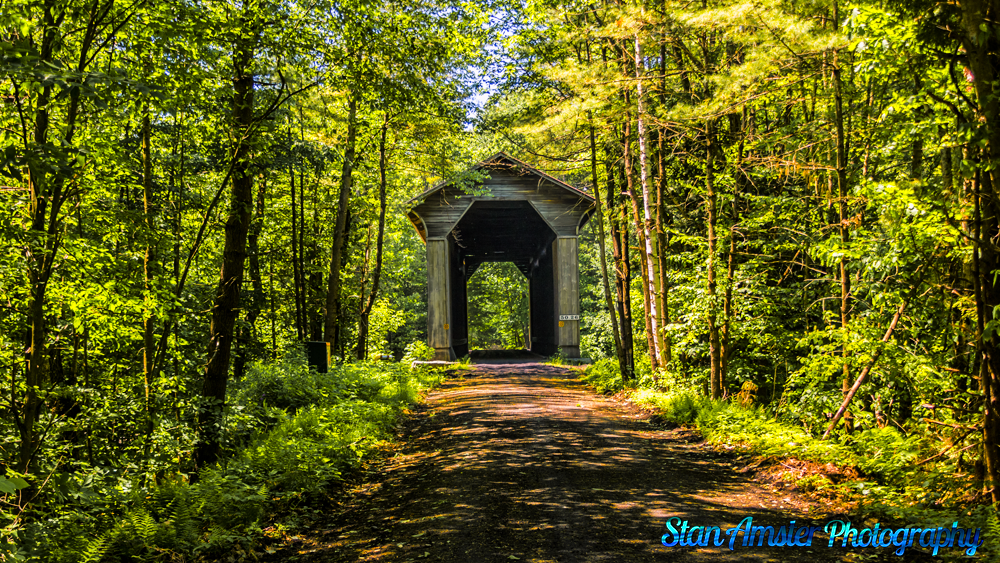
Wright’s Bridge is a historic covered bridge in Newport, New Hampshire. Originally built in 1906 to carry the Boston and Maine Railroad across the Sugar River, it now carries the multi-use Sugar River Trail. The bridge was listed on the National Register of Historic Places in 1975.
Wright’s Bridge is located in a rural setting in western Newport, spanning the Sugar River about 1,200 feet (370 m) west of the trail’s intersection with Chandler Mill Road. The bridge is a single-span Town double-lattice truss structure which has been reinforced by laminated arches. The bridge spans 122 feet (37 m), with 6 feet (1.8 m) of overhang at each end, and rests on granite abutments. Its exterior is finished with vertical board siding extending to about 2 feet (0.61 m) below the eaves. The portals have vertical boards along the sides, and horizontal boards above the opening. Elements of the trusses and arches are joined by a combination of wooden pegging, iron reinforcing rods, and metal turnbuckles.
The bridge is named for S. K. Wright, who sold this portion of the railroad right-of-way in 1871. The first bridge on the site was built soon afterward, by the Sugar River Railroad which originally built this section of railroad. Its successor, the Boston & Maine, built this replacement structure in 1906.
Wright’s Bridge in Newport New Hampshire Read More »
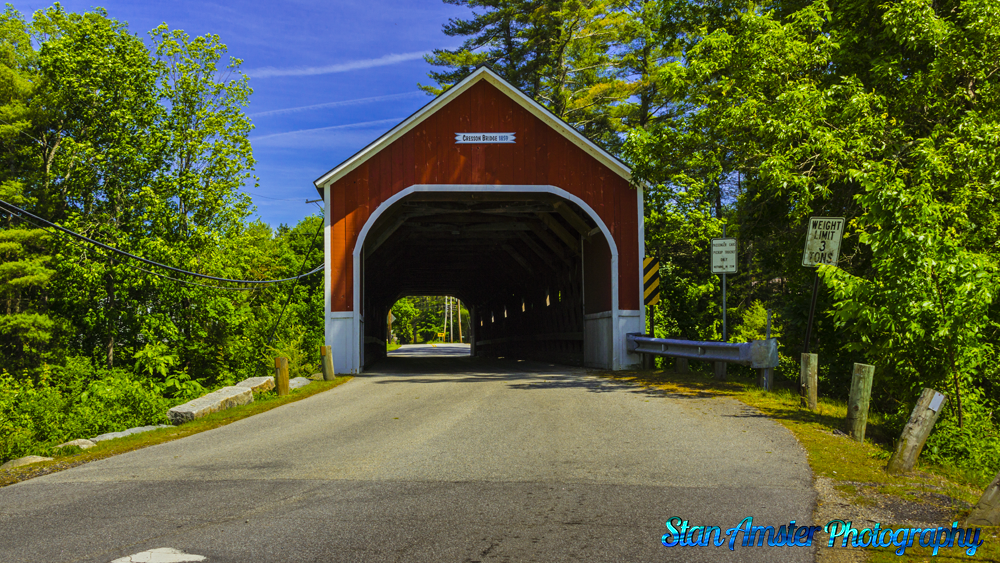
The Sawyers Crossing Covered Bridge, also known as the Cresson Bridge, is a wooden covered bridge carrying Sawyers Crossing Road over the Ashuelot River in northern Swanzey, New Hampshire. Built in 1859 to replace an older bridge, it continues to serve as a part of Swanzey’s transportation network, and is one of the state’s few surviving 19th-century covered bridges. It was listed on the National Register of Historic Places in 1978.
Sawyers Crossing Covered Bridge in Swanzey New Hampshire Read More »
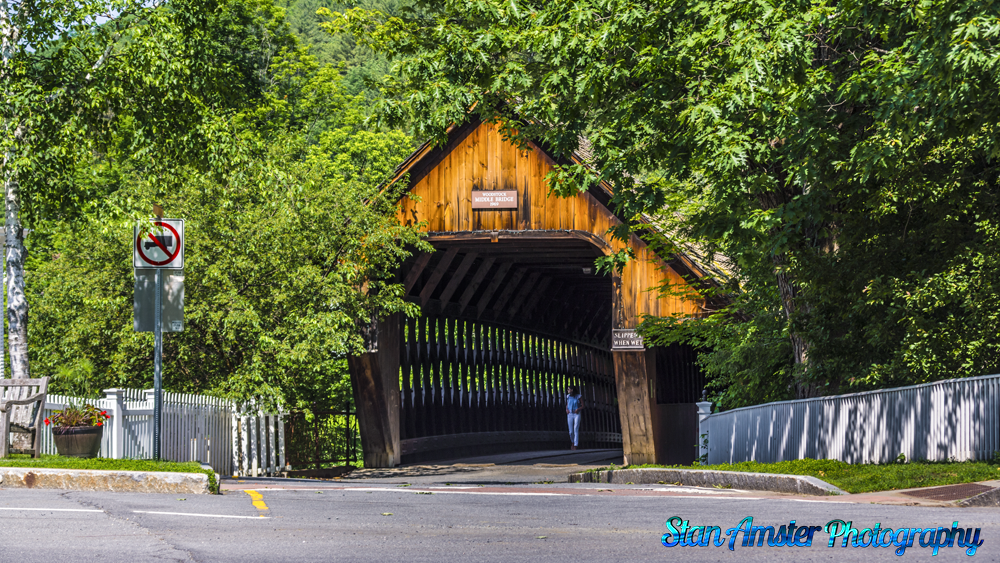
The Middle Covered Bridge in Woodstock was built in 1969 replacing an iron bridge that had been in use since 1877. The Middle Covered Bridge was constructed following traditional methods. Wooden pegs were used instead of nails, and the bridge was built on dry land and then pulled across the river on scaffolding drawn by oxen walking a capstan. With every turn of the capstan the bridge was pulled 3 1/3 inches closer to its final destination
On May 11, 1974, the bridge was set afire by arsonists. It took three years, and almost $55,000 to complete the required repairs.
In addition to the Middle Covered Bridge in the village, Woodstock has two other covered bridges, which are located in the hamlets of Taftsville and West Woodstock. The Taftsville Covered Bridge was severely damaged in 2011 by Tropical Storm Irene. After extensive renovations it reopened in 2013.
Middle Covered Bridge in Woodstock Vermont. Read More »